Inside Azadpur Mandi: Asia's Largest Fruit & Vegetable Market
1. Orientation
Q1. What is Azadpur Mandi, and where is it?
Azadpur Mandi is a wholesale market for fruits and vegetables in the Azadpur neighbourhood in North Delhi. The nearest metro station is Azadpur, on the Yellow Line. The produce that passes through here later reaches grocery shops, restaurants, hotels, and homes across Delhi and beyond.
View Azadpur Mandi on Google Maps →
Q2. How big is it, and how much produce moves through it every day?
The mandi covers around 75 to 80 acres. It is one of the largest fruit and vegetable wholesale markets in Asia, and by some counts the largest.
Every day, between 12,000 and 15,000 tonnes of fruits and vegetables arrive here. On a busy day, that is the equivalent of over 1,000 fully loaded trucks — most of them arriving and trading before sunrise.
Q3. When was it established, and why was it built?
Azadpur Mandi opened in 1977. Before that, Delhi's wholesale fruit and vegetable trade was handled by older, smaller markets in the city centre — mainly Subzi Mandi and Naya Bazar. As Delhi grew rapidly through the 1960s and 1970s, those markets became too small and too congested.
The government decided to build a large, purpose-designed wholesale market on the city's outskirts, where there was more space and better road access for trucks arriving from across India. Azadpur was chosen for this reason.
Q4. Who runs it?
Azadpur Mandi is managed by the Agricultural Produce Marketing Committee (APMC), Azadpur, operating under the Delhi Agricultural Marketing Board. The APMC issues licences to traders and commission agents, sets the rules for auctions, and collects market fees.
The day-to-day trading involves thousands of private participants: commission agents (arhatiyas), traders, transporters, loaders, and buyers. The APMC provides the legal framework and physical infrastructure; the private participants do the actual trading.
2. How the market works
Q5. What are the opening days and hours? Is it open on Sunday?
Azadpur Mandi operates seven days a week, including Sundays. The main wholesale activity starts very early — most arhatiyas open at 3:00 to 4:00 AM, and the peak of trading is over by 8:00 or 9:00 AM. By mid-morning, the busiest part of the day is already done.
Secondary trading — smaller buyers, retailers picking up remaining stock — continues through the afternoon. Sunday is a lighter day, but the market does not close. Perishable produce cannot wait for a day off.
Q6. Are there any days in the year when it's closed?
The mandi typically closes on the main day of Holi and on Diwali. Republic Day and Independence Day may see reduced operations, though not a full closure.
Beyond official holidays, the market can shut down without notice due to strikes called by trader associations — usually over policy disputes such as APMC fee changes or transport regulations. Severe weather, particularly heavy monsoon flooding in the Azadpur area, has also caused ad-hoc closures. The APMC publishes the official holiday list each year; for a specific date, calling the mandi office directly is the safest check.
Q7. Who are the main players?
The arhatiya (commission agent) is the central figure. Farmers or their representatives consign produce to an arhatiya, who sells it on their behalf and takes a commission — typically 6% in Delhi. The arhatiya provides credit, storage space, and market access; for many small farmers, he is also the only buyer they know.
Licensed traders and wholesalers buy from arhatiyas and sell onward to retailers, institutions, and smaller mandis across the region. Farmers and farmer-producer organisations (FPOs) arrive directly from source states, often after a night-long journey. And then there is a large workforce of palledars (loaders), weighmen, truck drivers, and sorters — tens of thousands of people whose income depends on the mandi running every morning.
Q8. How does a typical auction work, from truck arrival to sale?
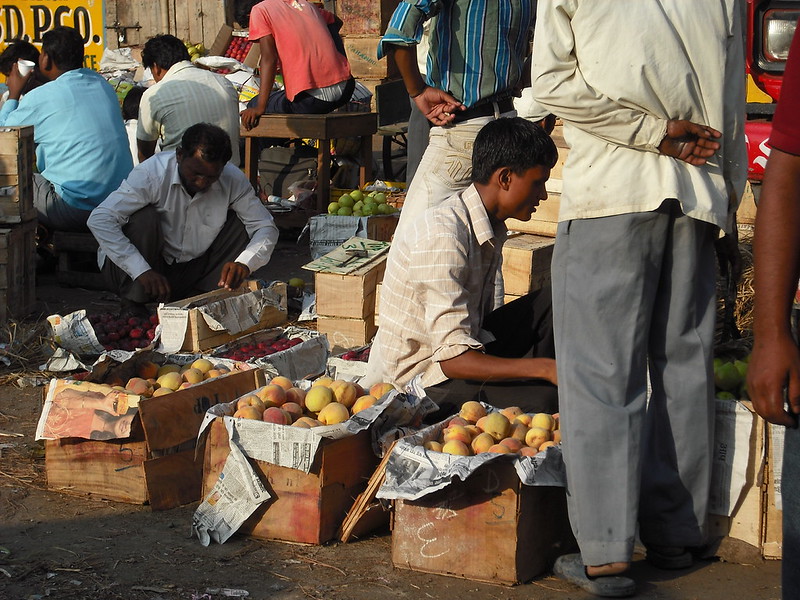
A truck arrives — often between midnight and 4 AM after travelling from Maharashtra, UP, Himachal, or further. The produce is unloaded into the arhatiya's lot. A weighman records the quantity. Buyers — traders, retailers, institutional purchasers — walk the lots, inspect the quality, and bid.
The auction is usually an open verbal process. The arhatiya calls out the lot; buyers make offers; the highest bid wins. Payment terms vary: established traders buy on short credit, smaller buyers pay cash. The farmer (or his representative) receives payment from the arhatiya after the commission is deducted. The whole cycle — unloading, auction, payment, loading onto the buyer's vehicle — can happen within a couple of hours.
Q9. How are prices set, and why do Azadpur rates influence the whole country?
Prices at Azadpur are set by supply and demand on any given morning. A large arrival of onions from Nashik drives prices down; a transport strike in Karnataka with no tomatoes coming in drives them up. Quality, variety, and the time of season all play a role.
What makes Azadpur rates nationally significant is scale and concentration. Because such a large share of North India's wholesale fruit and vegetable trade passes through this one market, the prices discovered here become the reference point for traders in Lucknow, Chandigarh, Jaipur, and dozens of smaller cities. Retail vegetable prices in Delhi's neighbourhoods on a given day often trace directly back to what happened at Azadpur that morning.
3. What's traded
Q10. What kinds of produce are sold at Azadpur?
Azadpur trades in fruits and vegetables only — no grains, no spices, no processed goods. Within that category, the range is very wide. On any given morning you will find over 20 varieties of fruit and more than 30 varieties of vegetables, from everyday staples to imported exotics.
The market serves every segment of Delhi's food economy: local kiranas, five-star hotel kitchens, school canteens, hospital catering, and large retail chains all buy here. That range of buyers is part of why such a variety of produce ends up at Azadpur in the first place.
Q11. Which commodities dominate by volume?
Three vegetables move in the largest quantities: potato, onion, and tomato. These are year-round staples, and the daily arrivals of each run into hundreds — sometimes thousands — of tonnes.
Among fruits, apple is the single biggest commodity and the one most associated with Azadpur's identity. Banana and mango (in season) follow in volume. Beyond these, significant quantities of citrus — oranges, kinnow, mosambi, lemon — trade daily, along with grapes, papaya, guava, and pomegranate.
Q12. Where does the produce come from?
Almost every Indian state sends produce to Azadpur. The major source regions by commodity:
- Potato: UP (Agra, Farrukhabad), Punjab, West Bengal (cold storage arrivals)
- Onion: Maharashtra (Nashik, Lasalgaon), MP, Karnataka, Rajasthan
- Tomato: Maharashtra, Karnataka, Himachal Pradesh (summer), Haryana
- Apple: Himachal Pradesh, Jammu & Kashmir — and imports from the US, Iran, Turkey, Chile, and New Zealand
- Banana: Maharashtra, Tamil Nadu, Andhra Pradesh
- Mango: UP (Dussehri, Langra), Maharashtra (Alphonso, Kesar), Andhra Pradesh, Bihar
- Citrus: Nagpur (oranges), Punjab (kinnow), AP and Maharashtra (mosambi)
- Garlic: Madhya Pradesh; Ginger: Northeast India and imports
Imported exotic produce — kiwi, pears, cherries, avocado, dragon fruit, broccoli, bell peppers — arrives in smaller volumes, mainly for the HoReCa segment and premium retail.
Q13. How do seasons change what's on offer?
The market's rhythm follows the agricultural calendar closely.
Winter (November–February) brings heavy arrivals of peas, cauliflower, carrots, radish, turnip, and leafy greens. Citrus peaks — Nagpur oranges and Punjab kinnow flood the market. Late-season apples from cold storage continue to arrive.
Summer (April–July) is mango season, and Azadpur becomes the main clearing house for North India's mango trade. Watermelon, muskmelon, and litchi (June) arrive in large quantities. Imported apples fill the gap left by domestic supplies winding down.
Monsoon (July–September) is the most volatile period. Tomato and onion arrivals become erratic — damaged roads, crop losses, and uneven supply cause sharp price swings. This is when Azadpur's price signals matter most to the national media and to government.
Q14. What role does Azadpur play in India's apple and onion trade specifically?
For apples, Azadpur is in a category of its own. A very large share of the domestic apple crop from Himachal and Kashmir passes through here before reaching the rest of North India. Imported apples from multiple countries arrive at Delhi and are distributed from Azadpur to secondary markets. When apple season opens in August–September, the mandi is visibly transformed — stacks of wooden crates from Shimla and Sopore fill entire sections of the yard.
For onions, Azadpur functions as a national price barometer. When onion prices spike in Delhi — which happens most years during the monsoon gap — it is the arrivals data and rates from Azadpur that the government monitors first. Traders, journalists, and policymakers watch the daily Azadpur onion rate the way equity traders watch an index. A shortage signal from here moves prices in cities hundreds of kilometres away within 24 hours.
4. Economic & social significance
Q15. What is the annual turnover, and how does it compare to other mandis?
Azadpur's annual turnover is estimated at ₹10,000 to ₹15,000 crore — roughly USD 1.2 to 1.8 billion at current rates. These are not audited figures; the mandi does not publish a consolidated annual report. The numbers circulate from APMC data, trader association estimates, and periodic government studies, and they vary depending on the year and commodity prices.
No other single fruit and vegetable mandi in India comes close to this scale. The nearest comparisons are Vashi (Navi Mumbai) and Koyambedu (Chennai), both large markets in their own right — but Azadpur handles a greater diversity of commodities and draws from a wider national supply chain than either.
Q16. How many people depend on Azadpur for their livelihood?
Direct employment at the mandi — arhatiyas, licensed traders, palledars, weighmen, truck drivers, cleaning staff — is estimated at 40,000 to 50,000 people on any active trading day. Many of these are daily-wage workers whose income stops if the mandi closes.
The indirect number is far larger. Farmers in Himachal, UP, Maharashtra, and Karnataka who send their produce to Azadpur, the transporters who carry it, the retail vendors across Delhi who buy from here, and the cold storage operators who hold stock between seasons — all of them depend on the market functioning. A serious disruption at Azadpur is felt across the entire Delhi food supply chain within 48 hours.
Q17. What does Azadpur mean for Delhi's food supply?
Delhi is a city of over 20 million people with almost no agricultural land of its own. Everything it eats comes from outside, and a very large share of that produce — estimates range from 60% to 70% of the city's daily fruit and vegetable supply — passes through Azadpur at some point in the chain.
This makes the mandi less a market and more a piece of critical infrastructure. When truck strikes, floods, or political disruptions close Azadpur even for a day or two, shortages appear in retail markets within hours and prices spike across the city. There is no backup system of comparable scale.
Q18. How does it connect smallholder farmers to urban consumers?
The typical Indian fruit or vegetable farmer holds a few acres. He cannot negotiate directly with a Delhi retailer, arrange his own transport, or wait weeks for payment. The arhatiya system at Azadpur — whatever its criticisms around commission rates and credit dependency — solves these problems. The farmer sends his produce with a trusted agent, the arhatiya finds a buyer that morning, and the farmer receives payment within days.
The result is that a smallholder growing kinnow in Hoshiarpur or cauliflower in Panipat can reach a market of 20 million people without leaving his district. Azadpur is the infrastructure that makes this connection possible — imperfect, often exploitative in its credit relationships, but functional at a scale that nothing else in India has yet replaced.
5. Challenges & modernization
Q19. What are the biggest problems the market faces today?
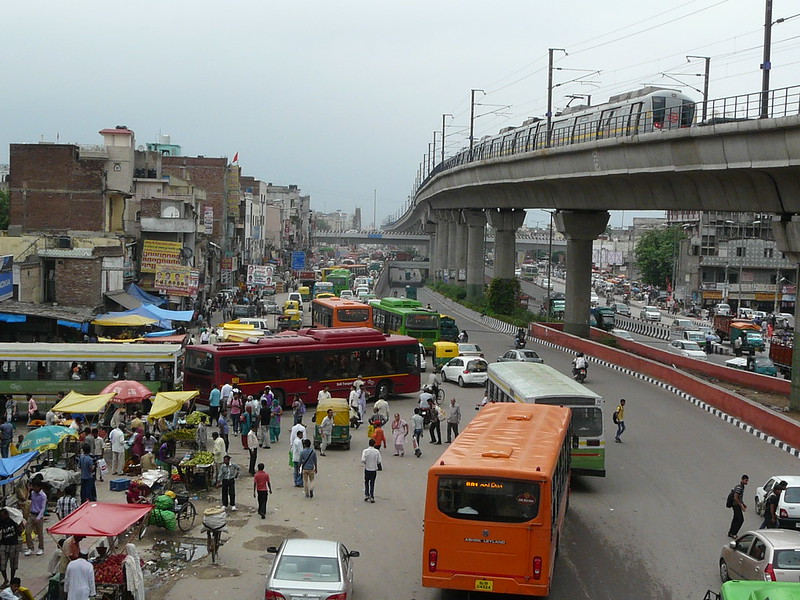
Congestion is the most visible problem. Azadpur was designed for a Delhi of the 1970s. The city has grown tenfold since then, and the number of trucks arriving each night has grown with it. The roads around the mandi — particularly the approach from GT Karnal Road — are routinely gridlocked between midnight and 6 AM. Trucks sometimes wait hours to unload. This delays the auction, compresses trading time, and adds cost at every step.
Infrastructure inside the mandi has not kept pace either. Cold storage capacity is limited relative to the volumes handled, drainage is poor, and large sections of the yard have no covered space. Produce sits exposed on the ground in summer heat and monsoon rain. Wastage — fruit and vegetables that spoil before they can be sold — is a chronic and largely unquantified problem. Estimates of post-harvest losses in Indian mandis generally run at 15% to 30% of arrivals; Azadpur is unlikely to be better than that average.
Q20. How has the APMC Act reform debate affected Azadpur?
The 2020 Farm Laws — which would have allowed farmers to sell outside APMC-regulated markets — were the most direct threat Azadpur's arhatiya community has faced. The laws were repealed in 2021 following sustained farmer protests, and the APMC system was preserved. But the debate left a mark: it made explicit, in very public terms, that the arhatiya model has critics as well as defenders.
For Azadpur itself, the practical impact of the repeal was a return to the status quo. The APMC fee structure, the licensing regime, and the arhatiya commission system all continue as before. The political pressure on mandis to modernise and reduce intermediary costs has not gone away, however. It is slower-moving now, but it has not disappeared.
Q21. What's being done about food waste and cold-chain gaps?
Progress exists but is uneven. The APMC has added some cold storage capacity at Azadpur over the years, and a number of private cold chain operators have set up facilities nearby. But the fundamental gap — between the volume of perishable produce arriving daily and the refrigerated infrastructure available to hold it — remains large.
The central government's schemes for cold chain development (under the Ministry of Food Processing) have funded projects across India, including in Delhi. Some of these benefit Azadpur indirectly through improved storage at source states. But the last-mile problem — the mandi yard itself, open to the elements, with no temperature-controlled receiving bays — has seen little structural change.
Q22. Is Azadpur going digital?
Partially. Azadpur is registered on e-NAM (the Electronic National Agriculture Market), the central government's platform for online trading in agricultural produce. In principle, e-NAM allows a farmer in Himachal to put his produce up for auction online and have it bought by a trader in Delhi without a physical intermediary. In practice, adoption at Azadpur has been limited. The arhatiya network is deeply entrenched, credit relationships are built on personal trust, and the physical inspection of produce — which buyers consider non-negotiable for fresh fruit and vegetables — is hard to replicate digitally.
What has changed more visibly is payments. UPI has replaced a large portion of the cash that once moved through the mandi. Digital weighing and record-keeping are more common than a decade ago. The mandi is not going paperless overnight, but it is incrementally less cash-dependent and more traceable than it was.
6. Visiting & practical info
Q23. Can outsiders visit the mandi? What's the best time to go?
Azadpur is a public market — there is no entry gate, no ticket, and no permission required to walk in. Farmers, traders, journalists, students, and curious visitors come and go freely. The mandi is not set up for tourism, but nobody will stop you from being there.
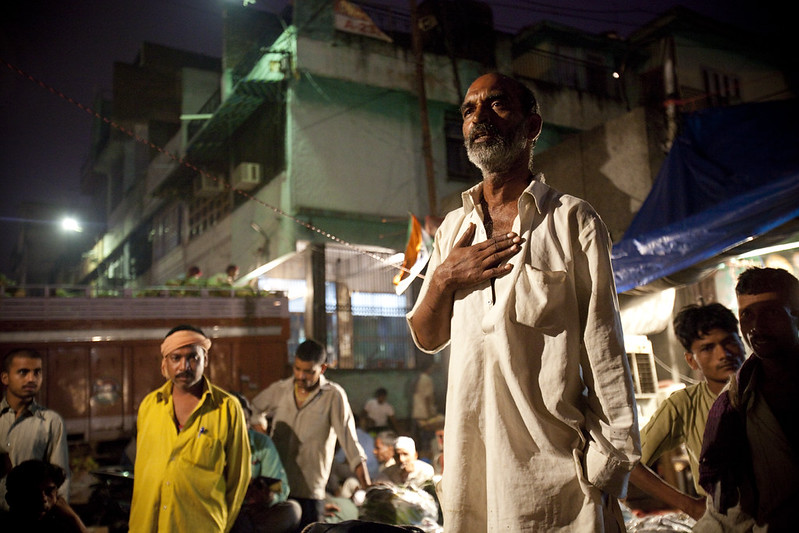
The best time to visit is between 3:30 AM and 7:00 AM. This is when the main auctions are running, trucks are being unloaded, and the market is at full intensity. By 9 AM, the peak is over and the yard starts thinning out. If you want to see the mandi as it actually functions — the noise, the speed, the scale — you need to be there before sunrise.
Q24. How do you get there?
By metro: Take the Yellow Line to Azadpur station. The mandi is a short walk from the station exit. This is the easiest option, especially for a pre-dawn visit when road traffic is unpredictable.
By road: The mandi sits off GT Karnal Road in North Delhi. From the city centre, take the road northward — Azadpur is well-signposted. Be aware that the roads immediately around the mandi are heavily congested between midnight and 7 AM due to truck movements. If you are driving, expect delays and limited parking near the main gates. Auto-rickshaws and cabs can drop you at the entrance without difficulty.
Q25. What should a first-time visitor expect?
Azadpur is not a tidy place. The yard is large, dimly lit before dawn, and crowded with trucks, crates, and palledars moving heavy loads at speed. The ground is often wet — from water used to keep produce fresh and from spillage during unloading. Wear closed shoes you don't mind getting dirty.
The noise is constant: diesel engines, verbal auction calls, the crash of crates being stacked, traders shouting bids. The smell varies by section — sharp and earthy near the onion lots, sweet near the fruit sheds. It is disorienting at first, but the market has a clear internal logic once you follow one auction through from start to finish.
A few things to keep in mind:
- Stay out of the way of loaders. Palledars move fast with heavy loads on their heads and cannot always see around them.
- Don't touch produce in an arhatiya's lot without asking — it is consigned goods, not yours to handle.
- Don't interfere with an ongoing auction. Watch from the side; the arhatiya and buyers are working quickly and don't welcome interruptions.
- Bring cash if you want chai from one of the small stalls inside — they don't take UPI.
Q26. Who do you contact for official data or to trade there?
To trade: Contact the APMC Azadpur office to apply for a trader's or commission agent's licence. The office is located inside the mandi complex. Licences are issued under the Delhi APMC Act and require documentation of business registration, identity proof, and a security deposit. The process takes several weeks.
For daily price and arrivals data: The best public source is AGMARKNET (agmarknet.nic.in), the government's national agriculture market data portal. Azadpur's daily commodity arrivals and modal prices are published there, usually with a one-day lag. The APMC office also publishes periodic market bulletins.
For media, research, or official inquiries: Contact the Delhi Agricultural Marketing Board (DAMB), which oversees the APMC. Their office is in New Delhi; contact details are available on the Delhi government website.
7. Closing
Q27. What does the future of Azadpur look like in the next 10 years?
The most likely near-term change is incremental modernisation within the existing structure — more cold storage, better drainage, digital record-keeping, and expanded UPI adoption — rather than any fundamental redesign. Proposals to relocate or expand the mandi to a larger site have surfaced periodically over the years, but none have moved to implementation. The political and commercial interests embedded in the current location are too entrenched for a clean break.
The bigger long-term pressure is from the direct sourcing movement — large retailers, quick-commerce platforms, and food-processing companies increasingly want to bypass the arhatiya layer and source directly from farmer-producer organisations. This is already happening at the margins. If it accelerates, Azadpur's role as the unavoidable intermediary for North India's produce could gradually weaken, even if the market itself continues to function.
What is unlikely to change is Azadpur's importance to Delhi's daily food supply. The city is too large, too dependent on complex supply chains, and too lacking in alternatives for the mandi to become irrelevant in any foreseeable timeframe. The question is not whether Azadpur will matter in 10 years — it will — but whether it will still be operating the same way it did in 1977.
Cover photo: mandi_azadpur_subzi_market_11 by Lam Thuy Vo, CC BY-NC 2.0